




If you've ever attended a sound bath, you may have walked away feeling lighter, calmer, or deeply rested. Some people describe it as the most relaxed they've felt in months. Others say they lost track of time, drifted into a dream-like state, or experienced a quietness that is difficult to put into words.
So, what is happening?
Can sound baths really help reduce stress?
The short answer is yes, they can—but perhaps not for the reasons many people think.
Understanding Stress
Stress isn't simply a busy schedule or a difficult day at work.
Stress is a physiological response.
When the brain perceives a challenge or a potential threat, the body prepares for action. Your heart rate increases, breathing becomes quicker, muscles tighten, and your attention narrows. This response is essential for survival and is often referred to as the fight-or-flight response.
The problem isn't that we experience stress.
The problem is that many of us spend so much of our lives in a heightened state of alertness that the body rarely has an opportunity to fully rest and recover.
This is where practices that encourage deep relaxation become valuable.
What Happens During a Sound Bath?
Unlike traditional meditation, a sound bath requires very little effort.
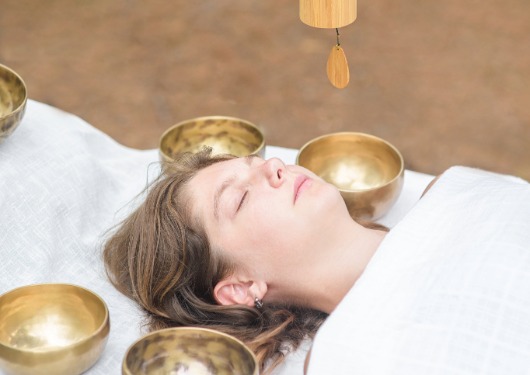
You simply lie down, close your eyes, and allow yourself to rest while listening to the soothing sounds and vibrations of instruments such as singing bowls, gongs, chimes, drums, and other resonant instruments.
There is nothing to achieve.
Nothing to control.
Nothing to perform.
For many people, this alone is a profound shift from the constant habit of doing.
How Sound Baths May Support Relaxation
We often think that relaxation begins in the mind.
But the body plays an equally important role.
Slow breathing, a sense of safety, and immersive sound all provide information to the nervous system that it may no longer need to remain on high alert. Whether through focused attention, gentle vibration, or simply the opportunity to rest without interruption, a sound bath creates conditions that allow the body to gradually move towards a state of ease.
Several factors may explain why many people report feeling less stressed after a sound bath.
The Mind Has Something Gentle to Rest Upon
When we're stressed, the mind often jumps rapidly between thoughts, worries, and unfinished conversations.
The rich, evolving sounds of a sound bath naturally draw our attention into the present moment. Instead of chasing every thought, awareness begins resting with the sound itself.
This gentle shift in attention can interrupt cycles of rumination and mental overactivity.
The Body Begins to Feel Safe
As you settle into stillness, breathing often becomes slower and more relaxed.
A slower breath supports activation of the parasympathetic nervous system—the body's natural state of rest, recovery, and restoration.
As this happens, heart rate gradually slows, muscles soften, and the body begins moving away from the stress response.
The sounds themselves are not forcing relaxation. Rather, they help create the conditions in which relaxation can naturally unfold.
Permission to Simply Rest
One of the most overlooked aspects of a sound bath is that it gives people permission to do absolutely nothing.
There are no emails to answer.
No conversations to manage.
No decisions to make.
For sixty minutes, you are simply invited to rest.
In a world that constantly rewards productivity, this intentional pause can itself become deeply restorative.
What Does the Research Say?
Research into sound baths is still evolving, and while the early findings are encouraging, more high-quality studies are needed to fully understand their effects.
Some studies have found that participants report reduced feelings of tension, anxiety, and negative mood following sound meditation sessions. Researchers believe these benefits may arise from a combination of focused attention, deep relaxation, immersive sound, and the opportunity to disengage from everyday stressors.
One researcher who has explored this area extensively is Dr. Lee Bartel, Professor Emeritus at the University of Toronto. His work suggests that sound and vibration may influence the nervous system through a process known as resonance. Rather than thinking of sound as something we only hear, Bartel describes it as a physical vibration that is also experienced by the body. He proposes that certain sound frequencies may support relaxation by encouraging the nervous system to shift away from a heightened stress response.
While this area of research continues to develop, it offers an intriguing scientific perspective on why so many people report feeling calmer, more rested, and deeply relaxed after a sound bath.
It is also important to distinguish between what research currently suggests and claims that go beyond the evidence. While specific claims about particular frequencies having unique healing properties are not yet well established scientifically, there is growing interest in understanding how immersive sound, vibration, focused attention, and deep relaxation together influence our physiological and psychological wellbeing.
Every Experience Is Different
No two sound bath experiences are exactly the same.
Some people remain awake throughout the session.
Others drift into a light sleep.
Some notice vivid imagery or emotions arising.
Others simply experience a profound sense of stillness.
There is no right or wrong experience.
The goal is not to make something extraordinary happen.
The invitation is simply to create space for the mind and body to settle in their own way.
Stress Doesn't Always Need to Be Fought
Many of us approach stress as something we need to overcome.
But sometimes, what we need most isn't another strategy.
It's an opportunity to pause.
To breathe.
To lie down.
To listen.
To remember what it feels like when the nervous system is no longer being asked to stay on high alert.
A sound bath doesn't remove the challenges from our lives.
What it can offer is something equally valuable: a chance to reconnect with a state of calm from which we can meet those challenges with greater clarity, resilience, and presence.
At Nihshreyasa, our sound baths are designed to create a supportive environment where the body can rest, the mind can soften, and stillness can naturally emerge. Whether you're experiencing a sound bath for the first time or returning to deepen your practice, each session is an invitation to slow down, reconnect with yourself, and discover the restorative power of simply being present.


-converted.webp)