



As a meditation facilitator, one of my favourite practices to guide is visualization meditation.
There's something quietly magical about it. From the outside, it doesn't look very different from any other meditation. Participants are lying comfortably with their eyes closed, barely moving. The room is silent except for the sound of my voice guiding them through an imaginary landscape. But inside each person's mind, something entirely different is unfolding.
One person may be walking barefoot along a quiet beach. Another may be sitting beneath an ancient tree. Someone else may be standing under a gentle waterfall, allowing years of tension to simply wash away. Although everyone is physically in the same room, each person is travelling through a deeply personal inner world.
As a facilitator, I never stop finding that beautiful. Over the years, I've also noticed something else. Some people find it very difficult to let go emotionally. If I simply ask them to "release" or "relax," they often struggle. The mind resists. The body holds on. Yet, during a visualization, something changes. Without trying so hard, they begin to soften. Some quietly shed tears. Some breathe more deeply. Some describe feeling lighter afterwards, even though they can't quite explain why. It has made me deeply curious about what is happening beneath the surface.
Fortunately, neuroscience is beginning to offer some fascinating insights. When we enter a deeply relaxed state through meditation, slow breathing, or practices such as a sound bath, the nervous system begins shifting away from constant alertness and towards rest. The analytical mind becomes quieter, attention naturally turns inward, and the imagination becomes more accessible. In this state, the brain becomes remarkably receptive to internally created experiences.
Imagine I gently invite someone to visualise placing a heavy backpack on the ground after carrying it for years. Or watching leaves float away on a slow-moving river. Or handing over a burden to the earth. Intellectually, we know none of these events are actually happening. Yet emotionally, something often shifts. The brain doesn't experience emotions only through logic. It understands symbols, stories, memories, and imagery in surprisingly powerful ways. Long before we analysed our emotions, we dreamed them. Long before we explained our experiences with words, we expressed them through stories and symbols. Visualization speaks that same language.
Research into imagination and the brain suggests that many of the neural networks involved in remembering the past, imagining the future, and reflecting on ourselves overlap significantly. One of these is the Default Mode Network, which becomes active during introspection, autobiographical memory, and mental simulation. This may help explain why a symbolic act inside a meditation can sometimes feel emotionally real. When someone imagines placing their worries into a small boat and watching it drift downstream, the conscious mind recognises it as a metaphor. But another part of the mind may experience it as a genuine act of letting go. That is why people sometimes become emotional during a visualization without fully understanding why. Nothing has changed externally. Yet something meaningful has shifted internally.
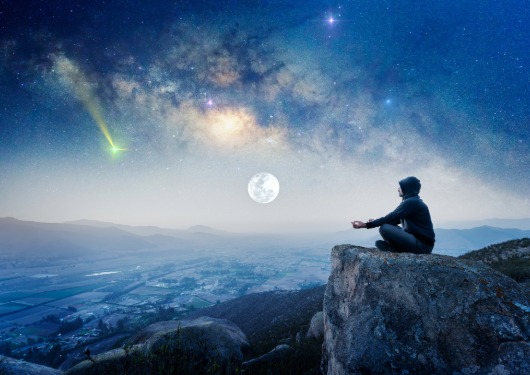
I've also come to believe that visualization offers something else that many of us desperately need. A sense of safety. People often think they let go because someone tells them to relax. In my experience, that's rarely how it works. We let go when the nervous system finally feels safe enough to do so. A quiet forest. A warm ray of sunlight. A peaceful mountain. A gentle river. These places may exist only in the imagination, but the feelings they evoke can be very real. The nervous system often responds more to perceived safety than to objective safety. That is why someone can feel anxious sitting in their own living room yet experience profound peace while imagining themselves beside a calm lake.
This is also why I love combining visualization with sound baths. The sound gently quietens the analytical mind and encourages the body to settle. As attention naturally turns inward, the visualization doesn't feel like something participants are trying to imagine. It begins to feel like somewhere they have genuinely arrived. The images stop being instructions. They become experiences. Perhaps that is the real beauty of visualization. It isn't about escaping reality. It isn't about pretending that life's challenges don't exist. It is about giving the mind and the nervous system an opportunity to rehearse something different. To experience what safety feels like. To experience what letting go feels like. To experience what freedom feels like - even if only for a few moments.
And sometimes, those few moments become the beginning of something much deeper. When participants open their eyes at the end of a visualization meditation, I'm often struck by the expressions on their faces. It's as though they've returned from somewhere. Not another country. Not another world. But another landscape within themselves. And perhaps that is where the most meaningful journeys have always begun.


-converted.webp)